
How cancer genes are activated shapes the effectiveness of next-generation protein-degrading drugs
A new study from the Degron Tagging Cluster Wood laboratory at the University of Edinburgh addresses an important but underexplored question in the targeted protein degradation field: does the mechanism by which an oncogene becomes overactive influence how effectively Proteolysis Targeting Chimaera (PROTAC) degraders eliminate the target protein?
The study, published this week in Cell Chemical Biology, represents another step towards a deeper understanding of how some cancers can be resistant to treatment whilst others positively respond, leading to favourable outcomes.
PROTACs are bifunctional small molecules that work by recruiting an E3 ubiquitin ligase to a target protein, inducing its ubiquitylation and subsequent proteasomal degradation. With over 25 now in clinical trials, there is a growing need to understand how the cellular context of target protein expression — in particular, the balance between synthesis and degradation that determines steady-state abundance — affects degrader performance.
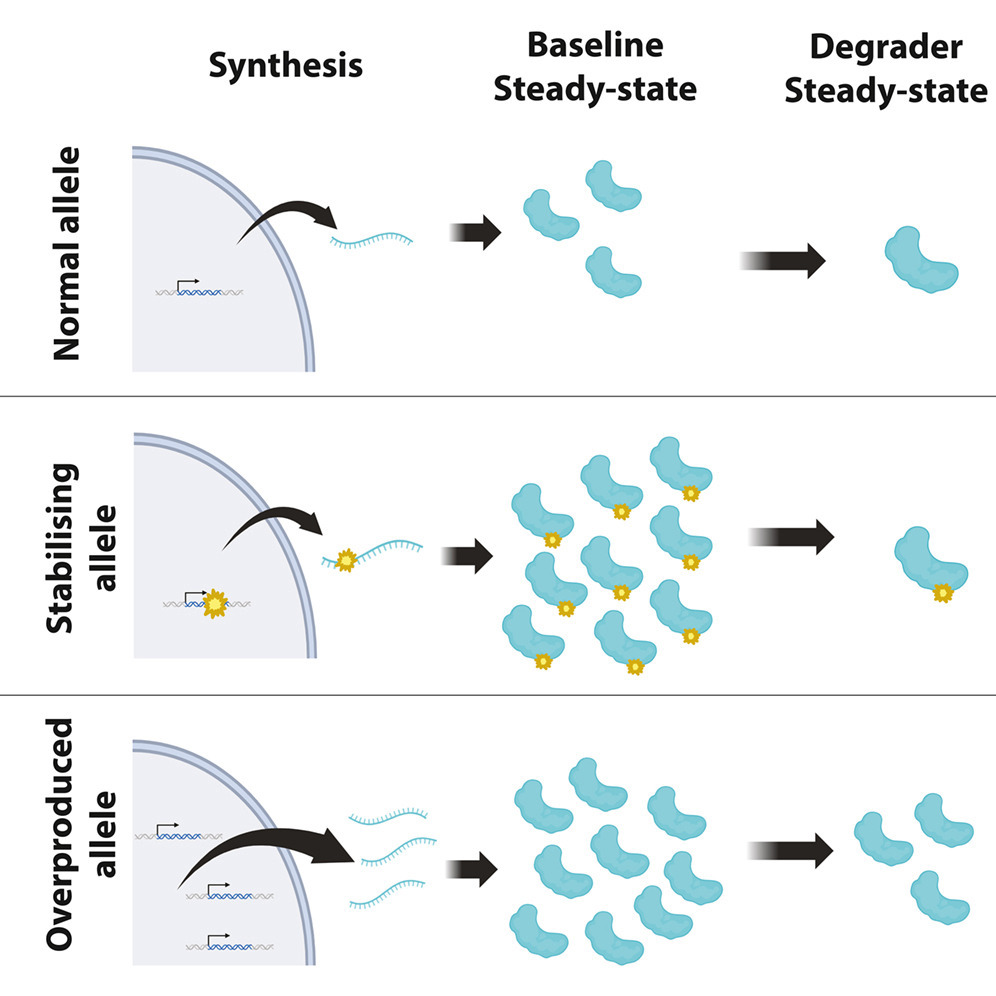
To address this, Gudauskaitė et al. engineered a panel of cell lines expressing β-catenin (CTNNB1) fused to a degradation tag (dTAG) degron and green fluorescent protein (GFP), allowing precise quantification of protein levels at single-cell resolution by flow cytometry. Critically, the system enabled the authors to distinguish between two common modes of oncogenic activation: mutations within β-catenin’s endogenous degron motif, which prevent proteasomal turnover and thereby extend protein half-life, and transcriptional upregulation, which increases the rate of new protein synthesis.
Three oncogenic degron mutations, S45F, T41A and S33F, elevated steady-state β-catenin levels up to 5-fold. Yet despite this elevated starting abundance, PROTAC treatment drove absolute protein levels down to the same minimum across all mutant and wild-type cell lines. In other words, mutations that stabilise the target protein raise the pre-treatment baseline but do not raise the post-treatment floor. The authors note an important methodological implication: because these mutations inflate the pre-treatment signal without affecting the post-treatment lowest point, assessing degrader performance by fractional reduction alone, the standard approach in the field, can be misleading, making stabilised proteins appear more sensitive to degraders than wildtype when in fact the absolute endpoint is the same.
The picture was different when β-catenin expression was driven up transcriptionally using a doxycycline-inducible system. Here, elevated synthesis raised protein levels both before and after PROTAC treatment. The fractional degradation maximum was unchanged, but the absolute post-treatment level was higher, consistent with a kinetic model in which the PROTAC-imposed steady-state is determined jointly by the rate of induced degradation and the rate of new synthesis. When synthesis is elevated, the achievable depth of depletion is limited accordingly.
Together, the findings provide a conceptual framework with practical implications for degrader drug development. Tumours harbouring mutations that stabilise a target protein — such as the common CTNNB1 exon 3 mutations or APC loss of function — may remain fully susceptible to PROTAC-mediated depletion despite high baseline protein levels. By contrast, gene amplification, which is rare for CTNNB1 but common for other candidate degrader targets such as cMYC, nMYC and EGFR, could represent a genuine resistance mechanism by raising the synthesis-dependent ceiling on depletion. The authors also flag adaptive upregulation of target synthesis under therapeutic pressure as an important area for future investigation.
Andrew Wood, lead of the Degron Tagging Cluster and last author on this paper: “We have known for some time that mutations which drive tumour growth can change the rate at which potential drug targets are synthesised or destroyed. Our study highlights the potential importance of understanding these genetic mechanisms, which can vary between patients, for predicting the efficacy of protein degrader drugs.”
This work was funded by the Medical Research Council and a Medical Research Scotland PhD studentship.